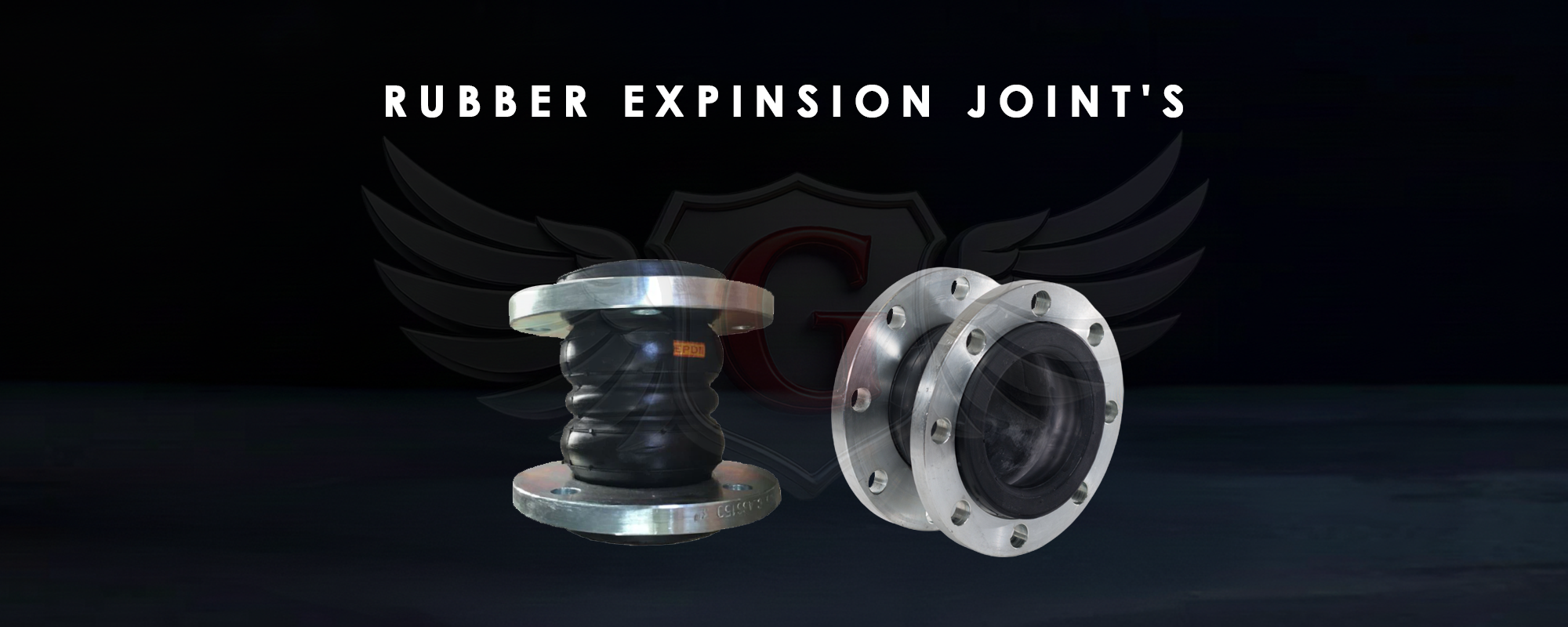


Rubber Expansion Joints are flexible, heavy-duty connectors designed for piping systems. They are constructed from elastomers (like EPDM or NBR rubber), reinforced with fabric and metal, and use flanged end connections.
Their primary purpose is to **absorb vibration and shock**, **dampen noise**, and **compensate for movement** (like thermal expansion and minor pipe misalignment). This makes them the #1 choice for protecting critical equipment like pumps, chillers, and cooling towers from the stresses of a piping system.
Our joints are the best solution for isolating vibration and noise from pumps and chillers, protecting your system and ensuring quiet operation.
We stock all common sizes (1" to 24") and can custom-fabricate large-diameter joints up to 48" or more for major projects.
We provide the right material for your fluid: **EPDM** for water, HVAC, and general use, or **NBR (Nitrile)** for petroleum, fuel, and oily applications.
Our standard joints feature floating (rotating) flanges, making bolt alignment during installation fast and easy, saving you time and labor.
The "arch" (or sphere/bellows) provides the flexibility. More arches = more movement.

The most common, versatile, and economical expansion joint. Provides excellent all-around movement and vibration damping.
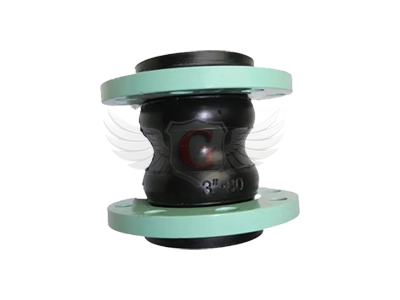
Features two bellows. This design allows for **significantly more** axial, lateral, and angular movement than a single sphere joint.

The standard connection. The flange is a separate ring that spins freely, making it easy to align bolt holes with the pipe flange.

For smaller sizes (typically 1" to 2"), joints are available with threaded union ends for easy installation on small pumps and equipment.
The internal elastomer must be compatible with the fluid being moved.
| Component / Elastomer | Common Use (Fluid Compatibility) | Limitations |
|---|---|---|
| EPDM (The Standard) | **Water.** This is the workhorse for HVAC (hot/chilled water), water/wastewater, and general industry. Excellent weather & heat resistance. | **DO NOT use for oil, fuel, or gasoline.** Petroleum products will cause EPDM to swell and fail. |
| NBR (Nitrile) | **Oils & Fuel.** The specialist for petroleum, diesel, oil, grease, and oily air applications. | Poor resistance to ozone and sunlight (weather). Not for strong acids. |
| Neoprene | The "all-purpose" option. Good resistance to moderate oils, chemicals, and weather. Common in marine applications. | Less resistant to oils than NBR; less resistant to heat than EPDM. |
| Reinforcement | Nylon Tire Cord, Synthetic Fabric, Steel Wire Helix (for suction) | The fabric provides the pressure rating. The optional **wire helix** prevents the joint from collapsing under vacuum. |
| Flanges | Carbon Steel (standard), 304/316 Stainless Steel | The rotating "floating" flanges are drilled to match pipe standards (ASME Class 150/300 or EN PN10/16). |
The specifications for every joint vary by manufacturer. The table below is an *example* of typical movement capabilities for a standard single sphere joint. **Twin sphere joints will offer more movement.**
| NPS (in / mm) | Face-to-Face (in) | Axial Compression | Axial Extension | Lateral Movement |
|---|---|---|---|---|
| 3" (DN80) | 6.00 | 0.75" | 0.50" | 0.50" |
| 4" (DN100) | 6.00 | 0.75" | 0.50" | 0.50" |
| 6" (DN150) | 6.00 | 0.75" | 0.50" | 0.50" |
| 8" (DN200) | 8.00 | 1.00" | 0.62" | 0.50" |
| 10" (DN250) | 8.00 | 1.00" | 0.62" | 0.50" |
| 12" (DN300) | 8.00 | 1.00" | 0.62" | 0.50" |
| 16" (DN400) | 10.00 | 1.25" | 0.75" | 0.50" |
| 20" (DN500) | 12.00 | 1.25" | 0.75" | 0.50" |
| 24" (DN600) | 12.00 | 1.25" | 0.75" | 0.50" |
Improper installation is the #1 cause of failure for rubber expansion joints.
Problem: This is the most common mistake. A joint is **NOT** a "flexible elbow." Using it to correct a badly misaligned pipe (static misalignment) puts it under constant stress and will cause it to fail prematurely.
Solution: The pipes *on both sides* of the joint must be **solidly anchored** to direct movement *into* the joint. An un-anchored joint will simply stretch out and burst from pressure thrust.
Problem: The seal is made by the raised rubber bead, not by extreme force. Over-tightening the bolts will crack the metal flange and crush the rubber, causing a leak.
Solution: Tighten bolts gradually and evenly in a **star (criss-cross) pattern**. This ensures the flange is pulled down flat and the gasket seats properly without being damaged.
It's a simple choice:
This is the force (Pressure x Area) of the fluid trying to push the joint apart. Because the bellows are flexible, this force is not contained by the joint itself—it must be absorbed by the **external pipe anchors**. If the anchors are not strong enough, the joint will stretch and burst.
ABSOLUTELY NOT. Petroleum and oils will cause **EPDM** rubber to swell, soften, and degrade, leading to a rupture. You **MUST** use an **NBR (Nitrile)** joint for any application involving oil, fuel, or grease.
A floating flange is a metal backing ring that is separate from the rubber body. It is free to spin 360°. This makes installation **much easier** because you don't have to struggle to align the bolt holes; you simply rotate the ring to match the pipe's flange.
Protect your pumps, chillers, and piping from stress, vibration, and noise. Contact the Glory team today with your size, fluid, and temperature, and we will provide the perfect expansion joint for your system.
Request a Quote Now